
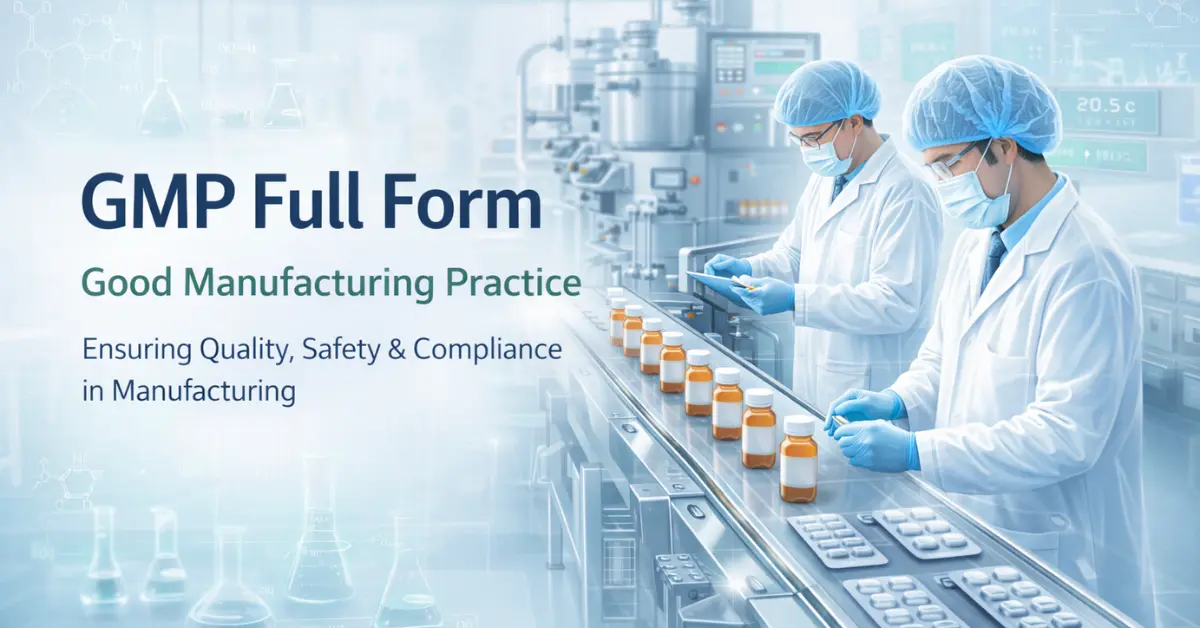
If you work in pharmaceuticals, health care, food, or manufacturing, you may have heard the term GMP. But many people still search online to understand the GMP Full Form and its real meaning.
The GMP Full Form is Good Manufacturing Practices, and it plays a critical role in ensuring product quality and safety across industries.
Let’s understand the GMP Full Form, its meaning, principles, guidelines, and practical importance in a simple and easy way.
GMP Full Form
GMP full form is Good Manufacturing Practices.
It refers to a system of rules, regulations, and guidelines that ensure products are consistently produced and controlled according to quality standards.
In simple words:
GMP ensures that medicines and products are safe, pure, and effective.
What Is GMP in Simple Terms?
Good Manufacturing Practices (GMP) is a quality assurance system that ensures:
- Products are manufactured under controlled conditions
- The right ingredients are used
- The correct process is followed
- The product is tested properly
- Proper documentation is maintained
GMP reduces risks like:
- Contamination
- Mix-ups
- Incorrect labeling
- Quality defects
Without GMP, medicines could become unsafe for patients.
Why Is GMP Important?
GMP protects:
Patients
Ensures medicines are safe and effective.
Manufacturers
Prevents legal issues, recalls, and financial losses.
Regulatory Authorities
Maintains public health standards.
A single GMP violation can result in:
- Product recall
- License suspension
- Heavy fines
- Factory shutdown
Core Principles of GMP (The 5 Pillars)
Most competitors do not clearly explain this. Here are the core pillars:
Personnel
- Trained staff
- Proper hygiene
- Defined responsibilities
Premises & Equipment
- Clean manufacturing areas
- Controlled temperature & humidity
- Validated equipment
Documentation
- Written procedures (SOPs)
- Batch manufacturing records
- Logbooks
Production Control
- Standardized processes
- Process validation
- In-process checks
Quality Control
- Raw material testing
- Finished product testing
- Stability studies
Together, these pillars ensure consistent quality.
Example: GMP in Tablet Manufacturing
Let’s understand GMP with a real-world example:
Imagine a company manufacturing paracetamol tablets.
Under GMP:
- Raw materials are tested before use
- Mixing time is fixed and validated
- Tablets are checked for weight variation
- Packaging is verified
- Batch records are signed and stored
If anything goes wrong, the batch can be traced immediately.
This is called traceability, a key GMP requirement.
Global GMP Standards
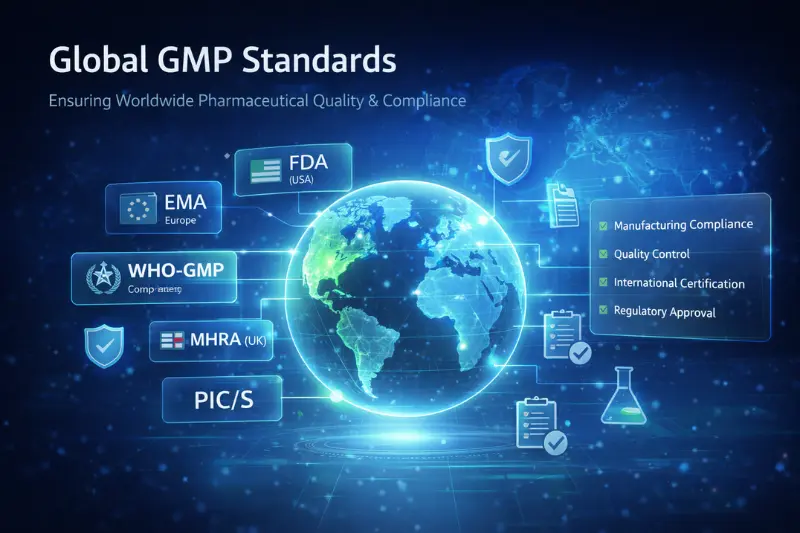
Different regions follow GMP regulations:
United States – CGMP
Regulated by the FDA (Food and Drug Administration)
Known as Current Good Manufacturing Practice (CGMP)
Defined under 21 CFR Parts 210 & 211.
European Union – EU GMP
Regulated by the European Medicines Agency (EMA)
Includes Annex guidelines for sterile products.
WHO GMP
World Health Organization guidelines
Adopted by over 100 countries.
Although wording differs, the principles remain similar.
GMP vs CGMP – What’s the Difference?
| GMP | CGMP |
|---|---|
| General term | “Current” GMP |
| Basic manufacturing standards | Updated modern standards |
| Used globally | Mainly used in USA |
CGMP emphasizes using up-to-date technology and systems.
GMP Documentation Hierarchy
Many articles ignore this important concept.
GMP documents follow a structured hierarchy:
- Quality Manual
- Standard Operating Procedures (SOPs)
- Batch Manufacturing Records (BMR)
- Work Instructions
- Logbooks
Documentation proves compliance during inspections.
What Happens During a GMP Inspection?
Regulatory authorities may inspect a facility to check:
- Cleanliness
- Training records
- Equipment validation
- Documentation accuracy
- Quality testing procedures
After inspection, they may issue:
- GMP Certificate
- Warning Letter
- Non-compliance notice
Companies must correct deficiencies immediately.
Common GMP Violations
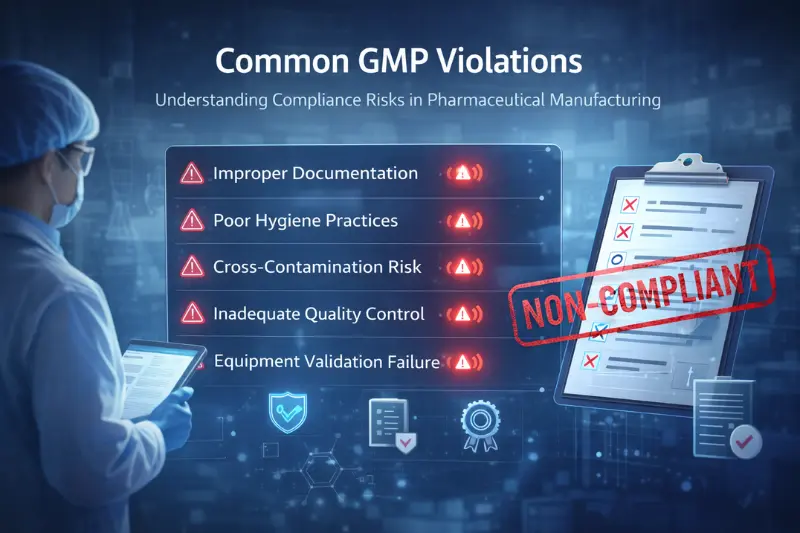
Understanding these helps manufacturers stay compliant:
- Poor documentation
- Untrained staff
- Equipment not calibrated
- Cross-contamination
- Incomplete batch records
Avoiding these mistakes is critical for compliance.
Modern GMP Concepts (Advanced but Important)
To make this guide more complete than competitors, here are modern GMP elements:
Risk-Based Quality Management
Identify and control risks before problems occur.
Data Integrity
All records must be:
- Accurate
- Complete
- Consistent
- Secure
Validation
Proving that processes work consistently.
Change Control
Every change must be documented and approved.
Industries Where GMP Applies
GMP is not only for pharmaceuticals. It also applies to:
- Food manufacturing
- Cosmetics
- Medical devices
- Dietary supplements
- Biotechnology
GMP vs Other Quality Systems
| System | Full Form | Purpose |
|---|---|---|
| GMP | Good Manufacturing Practices | Product manufacturing quality |
| GLP | Good Laboratory Practice | Laboratory testing standards |
| GDP | Good Distribution Practice | Storage & transport quality |
Benefits of Implementing GMP
- Improves product quality
- Builds customer trust
- Reduces product recalls
- Increases global market access
- Enhances brand reputation
Frequently Asked Questions (FAQs)
What is the GMP full form?
GMP stands for Good Manufacturing Practices.
What is GMP in pharmacy?
It is a system that ensures medicines are consistently manufactured and controlled according to quality standards.
Who regulates GMP?
Regulatory authorities like the FDA (USA), EMA (EU), and WHO set GMP guidelines.
Is GMP mandatory?
Yes. Manufacturers must comply with GMP to legally produce medicines.
What is the difference between GMP and ISO?
GMP focuses on manufacturing safety, while ISO covers broader quality management systems.
Final Words
Understanding the GMP full form is just the beginning. Good Manufacturing Practices form the backbone of safe pharmaceutical production worldwide.
Whether you are a student, pharmacist, manufacturer, or regulatory professional, GMP ensures one simple thing:
Every product reaching the patient is safe, effective, and high quality.
By implementing proper GMP systems, companies protect public health and build long-term trust.
