
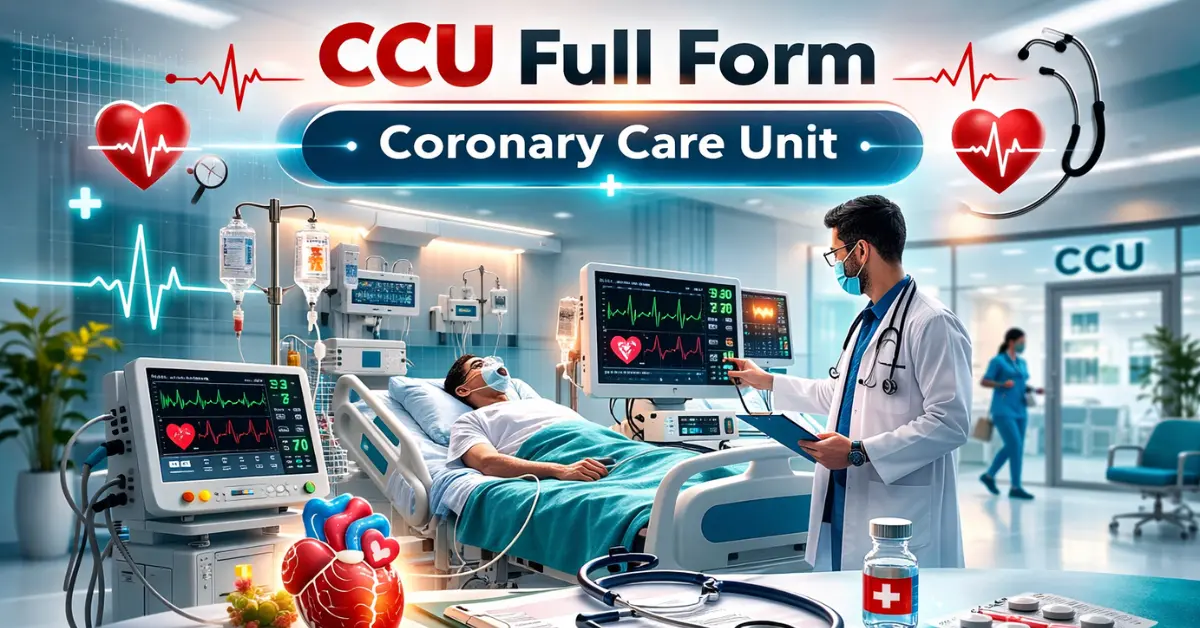
When someone hears the term CCU, it usually relates to serious medical care inside a hospital. But what exactly is the CCU full form, and how is it different from ICU?
In this complete guide, you’ll learn:
- CCU full form in medical terms
- Types of CCU
- What happens inside a CCU
- Difference between CCU and ICU
- Admission criteria
- Equipment used
- Length of stay
- Who needs CCU care
What is the CCU Full Form?
The CCU full form in medical terminology can have two meanings depending on the hospital structure:
- Cardiac Care Unit
- Critical Care Unit
Both are specialized hospital departments that provide intensive monitoring and treatment to critically ill patients. However, their focus and patient population differ significantly.
Cardiac Care Unit
A Cardiac Care Unit (CCU) is a specialized hospital unit dedicated to treating patients with serious heart-related conditions.
It is also known as:
- Coronary Care Unit
- Cardiovascular Intensive Care Unit (CVICU)
- Cardiac Intensive Care Unit (CICU)
Who Needs a Cardiac Care Unit?
Patients admitted to a Cardiac CCU usually experience:
- Heart attack (myocardial infarction)
- Severe arrhythmias
- Acute heart failure
- Unstable angina
- Complications after heart surgery
- Cardiogenic shock
What Happens Inside a Cardiac CCU?
Patients in a cardiac care unit receive:
- Continuous ECG monitoring
- Blood pressure and oxygen saturation monitoring
- Cardiac enzyme testing
- Emergency defibrillation if required
- Temporary pacemaker support
- Preparation for angioplasty or cardiac surgery
The unit is staffed by cardiologists, cardiac nurses, and trained technicians who specialize in heart emergencies.
Critical Care Unit
In some hospitals, the CCU full form refers to Critical Care Unit, which is often used interchangeably with ICU (Intensive Care Unit).
Unlike a cardiac CCU, this unit treats life-threatening conditions affecting multiple organ systems.
Conditions Managed in a Critical Care Unit
Patients admitted here may have:
- Respiratory failure requiring ventilator support
- Multi-organ failure
- Severe infections (sepsis)
- Major trauma (head or spinal injury)
- Post-surgical complications
- Stroke
- Severe burns
Equipment Used in a Critical Care Unit
The Critical Care Unit uses advanced life-support technologies, including:
- Mechanical ventilators
- Dialysis machines
- Infusion pumps
- ECMO (Extracorporeal Membrane Oxygenation)
- Central venous lines
- Continuous vital sign monitoring systems
CCU vs ICU: What is the Difference?
Many people confuse CCU and ICU. The main difference depends on whether CCU refers to Cardiac Care Unit or Critical Care Unit.
Here is a clear comparison:
| Feature | Cardiac Care Unit (CCU) | Intensive/Critical Care Unit (ICU) |
|---|---|---|
| Main Focus | Heart-related emergencies | All life-threatening conditions |
| Patient Type | Cardiac patients | Trauma, infection, organ failure, surgical patients |
| Specialists | Cardiologists | Intensivists and critical care specialists |
| Equipment | ECG monitors, pacemakers, defibrillators | Ventilators, dialysis machines, ECMO |
| Length of Stay | Usually shorter | Depends on condition severity |
In simple terms, a Cardiac CCU focuses only on heart conditions, while an ICU manages critical illnesses across all organ systems.
Admission Criteria for CCU
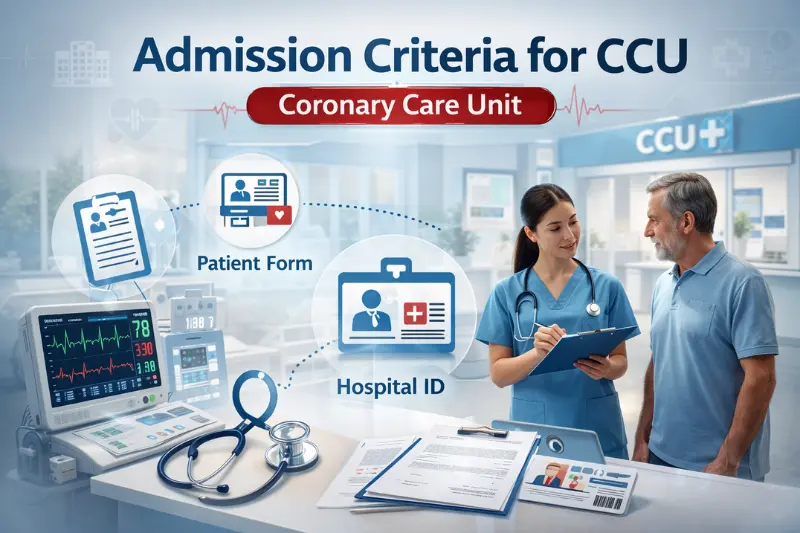
Admission to a Cardiac Care Unit may occur if a patient experiences:
- Severe chest pain with ECG changes
- Confirmed heart attack
- Dangerous heart rhythm disturbances
- Acute heart failure
- Complications after heart surgery
Admission to a Critical Care Unit depends on:
- Need for ventilator support
- Organ failure
- Severe infection
- Life-threatening medical or surgical condition
How Long Do Patients Stay in CCU?
Length of stay depends on the severity of the condition.
- Cardiac CCU: Often 1 to 5 days if stabilized early
- Critical Care Unit: May range from a few days to several weeks
Once stabilized, patients are transferred to step-down units or general hospital wards.
Why CCU Is Important in Modern Healthcare
The CCU plays a vital role in saving lives because:
- It provides immediate emergency response
- Continuous monitoring prevents sudden deterioration
- Specialized staff improve survival rates
- Advanced machines support failing organs
Without CCU facilities, survival rates for heart attacks and critical illnesses would be significantly lower.
Technological Advancements in CCU

Modern CCUs now use advanced technologies such as:
- AI-based cardiac rhythm monitoring
- Portable echocardiography
- Tele-ICU monitoring systems
- Advanced ECMO support
- Automated infusion pumps
These innovations help improve patient outcomes and reduce complications.
Frequently Asked Questions (FAQs)
Is CCU more serious than ICU?
Both treat critically ill patients. A Cardiac CCU focuses specifically on heart conditions, while an ICU treats a broader range of life-threatening illnesses.
Can a heart patient be treated in ICU instead of CCU?
Yes. In hospitals without a separate Cardiac CCU, heart patients are treated in the ICU.
Is CCU only for heart attack patients?
No. It also treats arrhythmias, heart failure, and post-cardiac surgery patients.
What is the difference between CCU and CICU?
CICU stands for Cardiac Intensive Care Unit and is essentially a specialized form of cardiac CCU with advanced cardiac life-support capabilities.
Conclusion
The CCU full form stands for either Cardiac Care Unit or Critical Care Unit, depending on the hospital setting.
- A Cardiac Care Unit focuses on serious heart conditions.
- A Critical Care Unit (similar to ICU) manages life-threatening conditions affecting multiple organs.
Both are essential components of modern hospitals and play a life-saving role in emergency and critical care medicine.
Understanding the CCU full form helps patients and families make informed decisions during critical health situations.
