

Have you ever wondered what “Rx” means on a doctor’s prescription?
You see it written at the top of almost every prescription slip, but most people do not know its real meaning, origin, or importance.
In this complete guide, you will learn:
- Rx full form
- The origin of the Rx symbol
- What Rx means in medical prescriptions
- The difference between Rx, NRx, and XRx
- Why Rx is written on prescriptions
- Legal and safety importance of Rx
Let’s break it down in simple language.
Rx Full Form
Rx Full Form: Recipe
The word “Rx” comes from the Latin word “Recipe,” which means “to take” or “take thou.”
In medical terms, Rx represents a prescription written by a licensed doctor.
What Does Rx Mean in a Prescription?
When a doctor writes Rx, it signals:
- “Take the following medicines as prescribed.”
It tells the pharmacist that the medicines listed below require a valid medical prescription.
Today, Rx is universally recognized as the symbol for a medical prescription across the world.
Where Did the Rx Symbol Come From?
The Rx symbol has a fascinating history.
1 Latin Origin
- Derived from the Latin word Recipe
- Meaning: “To take”
2 Historical Usage
- Used as early as the 16th century
- Doctors wrote “Recipe” before listing ingredients for medicine
- Later shortened to “Rx” for convenience
3 Modern Use
- Became a common noun in the early 20th century
- Now represents a doctor’s prescription globally
Some historians also suggest the symbol may be connected to the Eye of Horus, an ancient Egyptian symbol of protection, though the Latin origin is widely accepted.
Why Is Rx Written on the Left Side of Prescriptions?
Traditionally, doctors write Rx at the top left corner because:
- It signals the start of medical instructions
- It separates diagnosis from treatment
- It maintains standard prescription formatting
This consistent structure helps pharmacists quickly identify prescription orders.
What Information Follows Rx?
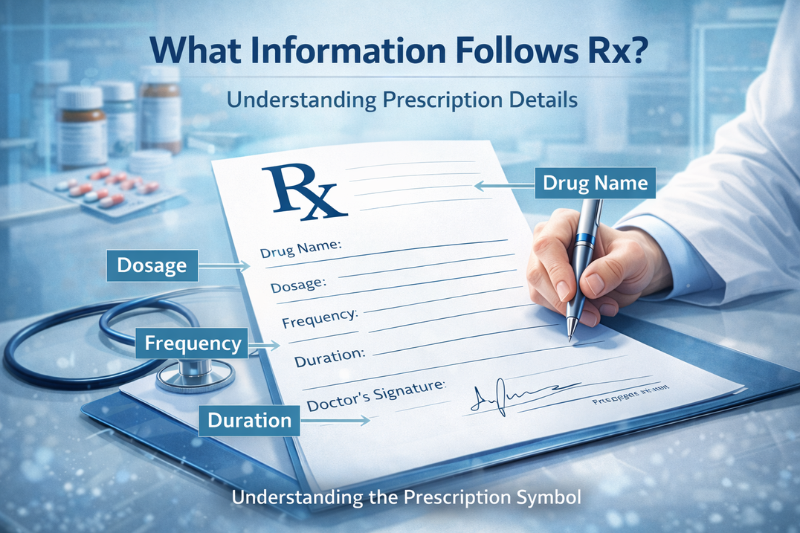
After Rx, doctors usually write:
- Name of the medicine
- Dosage (e.g., 500 mg)
- Frequency (e.g., twice daily)
- Duration (e.g., 5 days)
- Special instructions (e.g., after meals)
Example:
Rx
Amoxicillin 500 mg
Take one capsule twice daily for 5 days
Difference Between Rx, NRx, and XRx
Many people are confused about these variations. Here is a simple explanation:
| Symbol | Meaning | Drug Category | Refill Rules | Control Level |
|---|---|---|---|---|
| Rx | General Prescription | Schedule H/H1 | Limited refill | Moderate |
| NRx | New Drug Prescription | Narcotic (Schedule H) | Fresh prescription required | High |
| XRx | Schedule X Drug | Strong psychotropic drugs | No refill | Very High |
What Is NRx?
- NRx Full Form: New Drug Prescription
- Used for certain narcotic medicines
- Requires a fresh prescription each time
- Regulated under narcotic control laws
- Used for anxiety, depression, or severe conditions
These medicines have a risk of dependence, so stricter rules apply.
What Is XRx?
- XRx is used for Schedule X drugs.
- Strong psychotropic or narcotic medicines
- Pharmacists must keep prescription copies for record
- Cannot be sold without strict documentation
- Highly regulated
Legal Importance of Rx
The Rx symbol is not just a tradition. It has legal significance.
In Most Countries:
- Prescription medicines cannot be sold without Rx
- Pharmacists must verify doctor authorization
- Selling without prescription can lead to penalties
This ensures patient safety and prevents misuse of medicines.
Why Is Rx Important for Patient Safety?
Rx helps protect patients in several ways:
Prevents Self-Medication
Many prescription drugs can cause harm if taken incorrectly.
Reduces Drug Abuse
Controlled medicines require proper monitoring.
Ensures Correct Dosage
Doctors adjust doses based on age, weight, and condition.
Avoids Drug Interactions
Doctors check compatibility with other medicines.
Common Myths About Rx
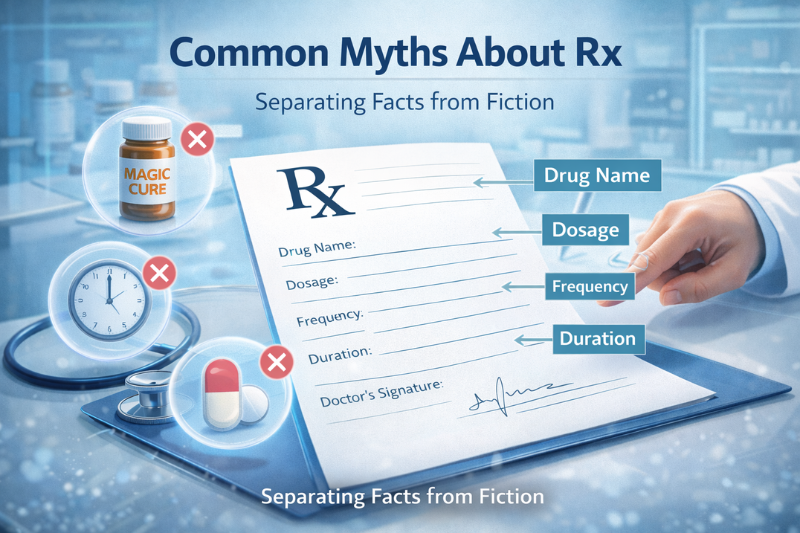
Myth 1: Rx Means Registered Medicine
No, it means “Recipe” (to take).
Myth 2: All Rx Drugs Are Dangerous
Not true. Many common antibiotics are Rx medicines.
Myth 3: Rx Is Just Decoration
Incorrect. It indicates legal prescription requirement.
Rx vs Over-The-Counter (OTC) Medicines
| Rx Medicines | OTC Medicines |
|---|---|
| Require prescription | No prescription needed |
| Doctor supervision required | Self-purchase allowed |
| Higher risk if misused | Generally safer for minor conditions |
Examples of OTC medicines:
- Paracetamol (low dose)
- Antacids
- Vitamin supplements
Frequently Asked Questions (FAQs)
What is the full form of Rx in medical terms?
Rx stands for “Recipe,” meaning “to take.”
Is Rx an abbreviation?
Technically, it is a symbol derived from Latin, not a standard abbreviation.
Why do doctors write Rx?
To indicate a prescription and begin treatment instructions.
Can pharmacists refill Rx medicines?
Some can be refilled, but narcotic drugs require new prescriptions.
Final Thoughts
Understanding the Rx full form helps you better understand how prescriptions work.
Rx means “Recipe” — a Latin term meaning “to take.” It marks the beginning of a doctor’s medical instructions and ensures medicines are used safely and legally.
The next time you see Rx on a prescription, you will know it represents more than just a symbol — it stands for safe medical practice.
