
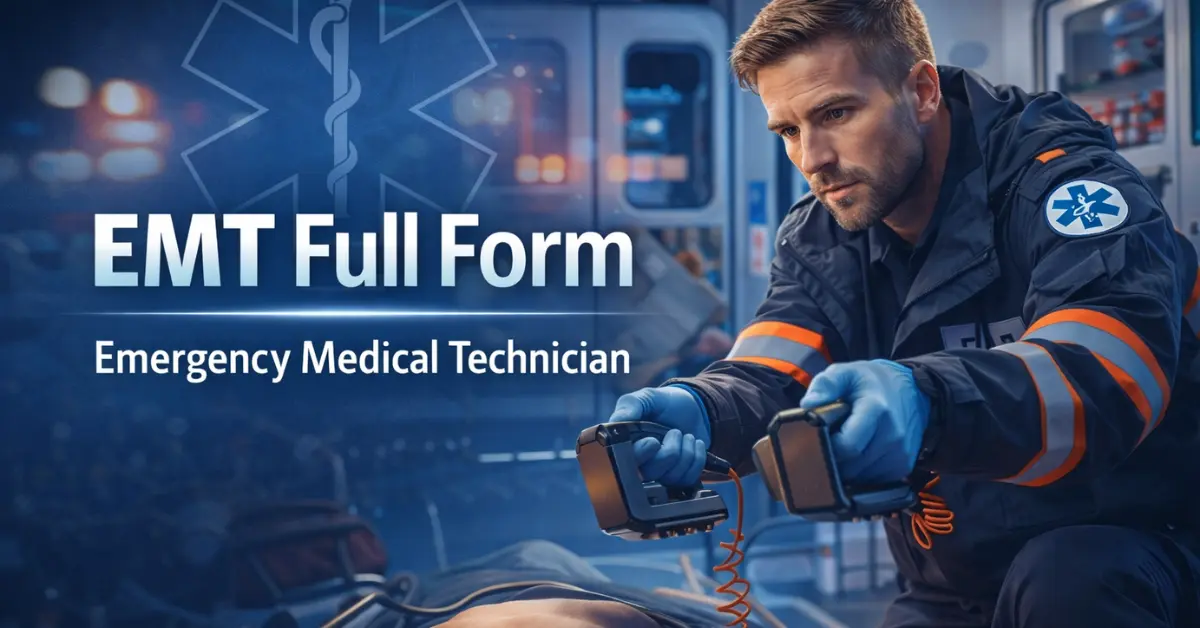
The EMT full form is Emergency Medical Technician.
An Emergency Medical Technician is a trained healthcare professional who provides immediate medical care to patients during emergencies such as accidents, heart attacks, injuries, and natural disasters. EMTs are often the first responders on the scene, helping stabilize patients before they reach a hospital.
This guide explains EMT in simple language, making it easy for students, beginners, and anyone interested in the medical field to understand.
EMT Full Form in Medical
| Term | Details |
|---|---|
| Full Form | Emergency Medical Technician |
| Category | Medical / Healthcare |
| Primary Role | Provide emergency care |
| Workplaces | Ambulances, hospitals, rescue teams |
| Training Required | Certification program |
| Key Skill | Fast decision-making |
What is an EMT?
An Emergency Medical Technician (EMT) is responsible for delivering basic life-saving treatment in critical situations. Their main goal is to keep patients stable while transporting them safely to a medical facility.
EMTs work in high-pressure environments where quick thinking and calm behavior can save lives.
In simple words:
- An EMT is the medical professional who arrives first during an emergency and begins treatment immediately.
Why Are EMTs Important?
EMTs play a crucial role in the healthcare system because emergencies require immediate attention.
Here is why they are essential:
- They reduce the risk of death by providing rapid care.
- They prevent conditions from worsening before hospital treatment.
- They support doctors and nurses by sharing patient information.
- They help manage disaster and accident situations efficiently.
Without EMTs, many patients would not receive timely care.
What Does an EMT Do?
EMTs perform a wide range of medical and rescue duties.
Common Responsibilities:
- Respond to emergency calls
- Assess the patient’s condition
- Provide first aid and life support
- Perform CPR when necessary
- Control bleeding and treat wounds
- Assist with childbirth in emergencies
- Use medical equipment such as oxygen masks and defibrillators
- Transport patients safely to hospitals
- Communicate with medical staff
Their work requires both medical knowledge and emotional strength.
Types of EMT
Many people do not realize that there are different levels of EMT training. Understanding these levels helps clarify career growth opportunities.
EMT-Basic
This is the entry-level position.
Responsibilities include:
- Basic airway management
- CPR
- Treating fractures and injuries
- Patient transportation
Advanced EMT (AEMT)
Advanced EMTs receive additional training that allows them to perform more complex procedures such as:
- Administering certain medications
- Starting IV fluids
- Using advanced airway devices
Paramedic
Paramedics represent the highest level of pre-hospital emergency care.
They can:
- Interpret ECG readings
- Provide advanced life support
- Administer a wider range of medications
- Perform critical medical procedures
EMT vs Paramedic: What Is the Difference?
| Feature | EMT | Paramedic |
|---|---|---|
| Training Duration | Shorter | Longer |
| Medical Skills | Basic life support | Advanced life support |
| Procedures | Limited | Complex |
| Responsibility | Patient stabilization | Critical care |
Both roles are vital, but paramedics handle more advanced medical situations.
Skills Every EMT Must Have
Being an EMT requires more than medical training. Personal qualities are equally important.
Essential Soft Skills:
- Quick decision-making
- Strong communication
- Compassion
- Emotional resilience
- Teamwork
- Problem-solving
Technical Skills:
- CPR and life support
- Trauma care
- Vital sign monitoring
- Emergency equipment handling
These skills help EMTs perform effectively under pressure.
Where Do EMTs Work?
EMTs are not limited to ambulances. They can work in various environments, including:
- Hospitals
- Fire departments
- Rescue services
- Air ambulances
- Police units
- Industrial sites
- Sports events
- Disaster response teams
This career offers both variety and stability.
When Should You Call an EMT?
You should seek emergency medical assistance immediately in situations such as:
- Severe chest pain
- Difficulty breathing
- Major injuries
- Heavy bleeding
- Unconsciousness
- Stroke symptoms
- Serious burns
Fast response can make the difference between life and death.
How to Become an EMT
One of the biggest advantages of this career is that it does not always require a traditional college degree.
Step-by-Step Process:
Complete High School or Equivalent
A diploma or equivalent qualification is typically required.
Enroll in an EMT Training Program
These programs teach anatomy, patient care, trauma response, and emergency procedures.
Gain CPR Certification
CPR training is mandatory for most EMT programs.
Pass the Licensing Exam
You must clear a national or state certification exam to practice legally.
Apply for EMT Jobs
After certification, you can begin working in emergency services.
Training duration usually ranges from a few months to one year, depending on the program.
EMT Salary and Job Outlook
EMTs earn competitive salaries, and the demand for emergency medical professionals continues to grow.
Factors that influence salary include:
- Location
- Experience
- Certification level
- Employer
As populations grow and healthcare needs increase, EMT careers are expected to remain stable and in demand.
Challenges of Being an EMT
While rewarding, the job can be physically and emotionally demanding.
Common challenges include:
- Long shifts
- Exposure to traumatic situations
- High-stress environments
- Physical exhaustion
However, many EMTs find the ability to save lives deeply fulfilling.
Benefits of Choosing an EMT Career
- Strong job stability
- Opportunities for advancement
- Fast entry into the medical field
- Meaningful and impactful work
- Valuable real-world skills
For those passionate about helping others, it is a highly respected profession.
Frequently Asked Questions
What is the full form of EMT?
The full form of EMT is Emergency Medical Technician.
Is an EMT a doctor?
No. EMTs are trained emergency responders but are not physicians.
How long does EMT training take?
Training typically takes a few months to one year.
Is EMT a good career?
Yes. It offers job security, growth opportunities, and the chance to make a real difference.
Quick Summary
- EMT stands for Emergency Medical Technician.
- They provide immediate medical care during emergencies.
- EMTs are often the first healthcare professionals to treat patients.
- Multiple certification levels allow career growth.
- The profession offers stability, purpose, and advancement opportunities.
