
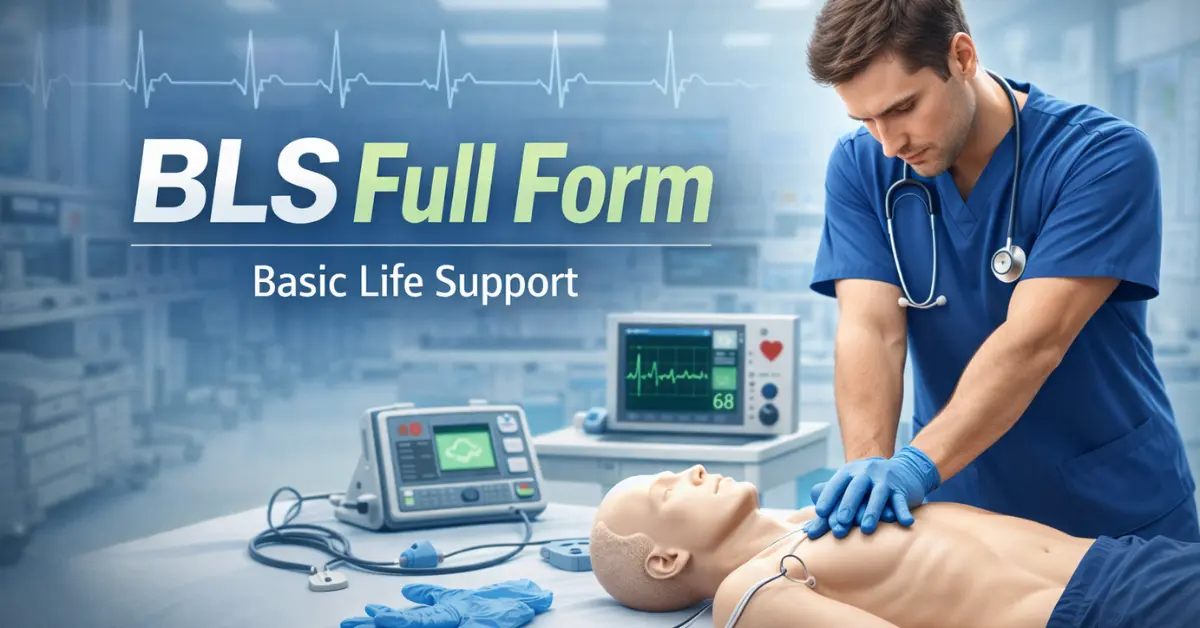
The BLS full form is Basic Life Support.
It refers to the initial medical care given to a person who is experiencing a life-threatening emergency such as cardiac arrest, breathing failure, or choking—before advanced medical help arrives.
This guide explains BLS in simple language, making it easy for students, beginners, and non-medical readers to understand.
What Is BLS (Basic Life Support)?
Basic Life Support (BLS) is a set of life-saving techniques used to keep a person alive when their heart stops, breathing stops, or their airway is blocked.
BLS focuses on:
- Maintaining blood circulation
- Supporting breathing
- Using an AED (defibrillator) if needed
- Preventing brain damage until medical professionals arrive
Why Is BLS Important?
BLS is critical because:
- Brain damage can start within 4–6 minutes without oxygen
- Early CPR can double or triple survival chances
- Immediate action saves lives in homes, offices, schools, and public places
Even non-medical people can save a life using BLS skills.
Key Components of Basic Life Support
BLS mainly includes the following elements:
Cardiopulmonary Resuscitation (CPR)
- Chest compressions to keep blood flowing
- Rescue breaths (if trained)
Use of AED (Automated External Defibrillator)
- Delivers an electric shock to restore normal heart rhythm
Airway Management
- Ensuring the airway is open and clear
Choking Relief
- Helping someone who cannot breathe due to a blocked airway
BLS Step-by-Step Process (Easy Flow)
- Check safety of the surroundings
- Check response (tap and shout)
- Call for emergency help
- Start CPR (if not breathing normally)
- Use AED as soon as available
- Continue care until help arrives
CPR Basics in BLS
Chest Compressions
- Rate: 100–120 compressions per minute
- Depth: About one-third of chest depth
- Allow full chest recoil
- Minimize interruptions
Compression to Breath Ratio
- 30 compressions : 2 breaths (for trained rescuers)
Types of CPR Used in BLS
Hands-Only CPR
- Only chest compressions
- Recommended for untrained or unsure rescuers
Traditional CPR
- Chest compressions + rescue breaths
- Used by trained individuals
Role of AED in BLS
An AED:
- Is portable and easy to use
- Gives voice instructions
- Detects abnormal heart rhythm
- Delivers shock only if needed
Using an AED early greatly increases survival chances.
Choking Management in BLS
Signs of Choking
- Unable to speak or breathe
- Hands on throat
- Blue or pale skin
- Weak or no coughing
5 & 5 Method
- 5 back blows
- 5 abdominal thrusts
Repeat until blockage clears or help arrives
Who Should Learn BLS? (Often Missing in Competitor Articles)
BLS is not only for doctors. It is useful for:
- Students
- Teachers
- Office workers
- Security staff
- Parents
- Drivers
- Fitness trainers
- General public
Anyone can become a life saver with BLS knowledge.
BLS vs CPR (Simple Comparison Table)
| Feature | BLS | CPR |
|---|---|---|
| Full Form | Basic Life Support | Cardiopulmonary Resuscitation |
| Scope | Broader | Part of BLS |
| Includes AED | Yes | No |
| Includes Choking Care | Yes | No |
| Used by | Medical & non-medical | Everyone |
Real-Life Situations Where BLS Is Used
- Sudden collapse at home
- Heart attack in public places
- Drowning incidents
- Workplace accidents
- Choking during meals
- Road accidents
Do’s and Don’ts of BLS
Do
- Act quickly
- Call for help early
- Push hard and fast during CPR
- Follow AED instructions
Don’t
- Panic
- Delay action
- Stop CPR unnecessarily
- Leave the victim alone
Common Myths About BLS (Unique Section)
- “Only doctors can perform BLS” → False
- “CPR always revives the person” → Not always, but it improves chances
- “I might harm the patient” → Doing something is better than nothing
Quick Summary (TL;DR)
- BLS full form is Basic Life Support
- It saves lives during cardiac arrest, breathing failure, and choking
- Includes CPR, AED use, and airway management
- Anyone can learn and perform BLS
- Early action makes the biggest difference
FAQs – BLS Full Form
What is the full form of BLS?
BLS stands for Basic Life Support.
Is BLS and CPR the same?
No. CPR is a part of BLS, while BLS includes CPR, AED, and choking care.
Can a non-medical person perform BLS?
Yes. With basic training, anyone can perform BLS.
Where is BLS used?
Hospitals, homes, offices, schools, roads, and public places.
Is BLS useful in daily life?
Absolutely. It prepares you to handle emergencies anytime, anywhere.
Final Note
Learning Basic Life Support means learning how to save a life.
You may never expect an emergency—but when it happens, BLS knowledge makes you powerful.
