
Introduction
Medical imaging technology has advanced rapidly, allowing doctors to detect diseases at much earlier stages than before. One such powerful diagnostic tool is the PET scan. Many people hear this term during serious medical evaluations but are not fully aware of its meaning or purpose. Understanding the PET Scan Full Form, how it works, and why it is used can help patients feel more confident and informed about their medical care.
PET Scan Full Form
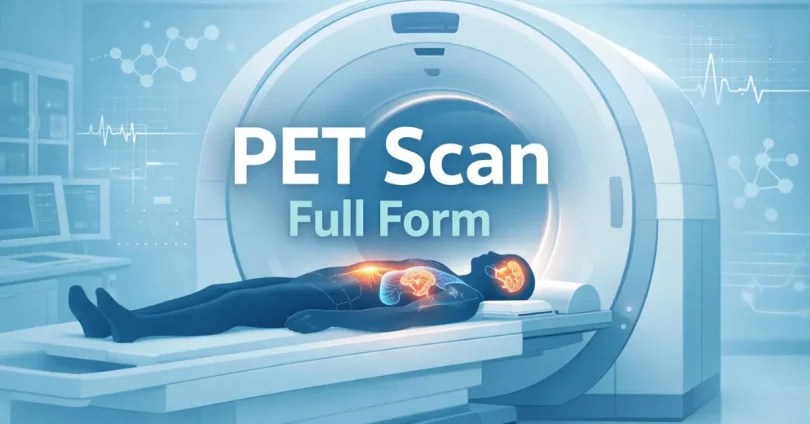
PET Scan Full Form is Positron Emission Tomography Scan.
A PET scan is an advanced medical imaging test that helps doctors understand how organs and tissues are functioning, rather than only showing their structure. It is commonly used to detect and monitor cancer, heart diseases, and brain disorders.
What Is a PET Scan?
A Positron Emission Tomography (PET) Scan is a type of nuclear medicine imaging test that uses a small amount of radioactive substance called a tracer to observe metabolic activity inside the body.
Unlike CT scans or MRI scans, which mainly show physical structure, a PET scan highlights cell activity and energy usage, allowing doctors to identify diseases at an early stage.
How Does a PET Scan Work?
A PET scan works through the following steps:
- A radioactive tracer (most commonly fluorodeoxyglucose or FDG) is injected into a vein.
- The tracer travels through the bloodstream and collects in organs and tissues.
- Cells that are more active absorb more tracer and appear brighter on the scan.
Diseased or cancerous cells usually consume more glucose, making them easier to detect during a PET scan.
PET Scan vs CT Scan vs MRI
| Imaging Test | Shows Structure | Shows Function | Uses Radiation |
|---|---|---|---|
| CT Scan | Yes | No | Yes |
| MRI | Yes | No | No |
| PET Scan | Limited | Yes | Yes (Low) |
PET scans are often combined with CT or MRI to provide more accurate and detailed results.
Why Is a PET Scan Done?
Doctors recommend PET scans for several medical purposes, including:
Cancer Detection and Monitoring
- Detecting cancer at an early stage
- Checking if cancer has spread
- Monitoring treatment effectiveness
- Identifying cancer recurrence
Heart Conditions
- Evaluating blood flow to the heart
- Assessing heart muscle damage
- Determining the need for bypass surgery or angioplasty
Brain Disorders
- Alzheimer’s disease
- Brain tumors
- Epilepsy and seizure disorders
- Dementia
Who Needs a PET Scan?
A PET scan may be recommended if:
- Other imaging tests are inconclusive
- Cancer is suspected or already diagnosed
- Treatment progress needs evaluation
- Neurological symptoms are present
How to Prepare for a PET Scan
Before a PET scan, patients are usually advised to:
- Avoid eating for 4–6 hours
- Drink only water
- Avoid heavy exercise before the scan
- Inform the doctor about pregnancy, breastfeeding, or diabetes
- Wear comfortable clothing without metal objects
What Happens During a PET Scan?
- The tracer is injected through an IV line
- The patient rests while the tracer spreads
- The scan takes 20–30 minutes
- Total procedure time is around 2–3 hours
The test is painless and non-invasive.
Is a PET Scan Safe?
PET scans are generally safe and involve very low radiation exposure.
Possible Risks
- Minimal radiation exposure
- Rare allergic reactions
- Not recommended during pregnancy unless necessary
Drinking water after the scan helps flush the tracer out of the body.
PET Scan Results
A trained radiologist examines the scan images and sends a report to the doctor, usually within 24 hours. The doctor then explains the results and next steps.
Advantages of PET Scan
- Detects diseases earlier than CT or MRI
- Shows real-time organ function
- Highly accurate for cancer staging
- Helps in personalized treatment planning
Limitations of PET Scan
- Not all cancers are visible
- Higher cost compared to basic scans
- Requires expert interpretation
FAQs on PET Scan Full Form
What is PET Scan full form?
PET Scan full form is Positron Emission Tomography Scan.
Is PET scan painful?
No, the procedure is painless except for a small injection.
How long does a PET scan take?
The entire process usually takes 2 to 3 hours.
Can PET scan detect cancer early?
Yes, PET scans can detect cancer before physical changes occur.
Is PET scan safe for children?
Yes, when performed under medical supervision and necessity.
Conclusion
The PET Scan Full Form – Positron Emission Tomography Scan describes a medical imaging technique that shows how cells and organs function inside the body. It helps doctors detect diseases early, evaluate treatment response, and make accurate medical decisions, especially in cases related to cancer, heart conditions, and brain disorders.